
DPI in the AI Era: Why we Need a Publicly-Owned Orchestration Layer
How governments can harness AI's potential within their DPI Stack, and avoid private capture
This piece builds on the DPI-AI Framework and The Agentic State White Paper.
AI promises to transform public service delivery. Effective ‘AI Agents’ can act autonomously to complete routine administrative tasks and improve the responsiveness of institutions, all while freeing government staff to focus on complex human challenges.
However, adopting Agentic AI in any sector is risky, especially in Government. Giving autonomous AI tools access to foundational systems of record is dangerous (see lessons from OpenClaw at a personal AI Assistant scale). Without clear safeguards, observability and oversight, such automation will compromise public accountability and ultimately degrade services. Poorly managed AI Agents put citizens and systems at risk.
An Orchestration Layer helps address these challenges by providing a platform through which to build, manage, control and audit workflows, which AI Agents can trigger and complete. Through this layer, AI Agents can be given controlled access to foundational building blocks (like identity systems, registries and payment platforms), and their actions can be managed as deliberately designed workflows in service of the public. The Orchestration Layer facilitates the safe technical execution of state capability based on citizens’ needs, while providing clear observability and oversight.
Given the foundational importance of this infrastructural layer, it must be run and owned in the public interest, not for private profit.
This piece serves to explain the details of how we’re thinking about this at OpenFn, and how we are providing this Orchestration Layer as a Digital Public Good.
The Promise of AI for DPI
Consider what happens when a citizen applies for a climate subsidy for their farm. To assess this application requires interacting with information scattered across departments and between systems. With effective system design though, the application process should follow a repeatable pattern, in line with defined policy. Fig 1 below shows an example of what that might look like.
Today, it often falls to caseworkers to manually bridge those gaps. Checking identity, navigating between systems to re-enter and update data, then interacting with the citizen based on the outcome.
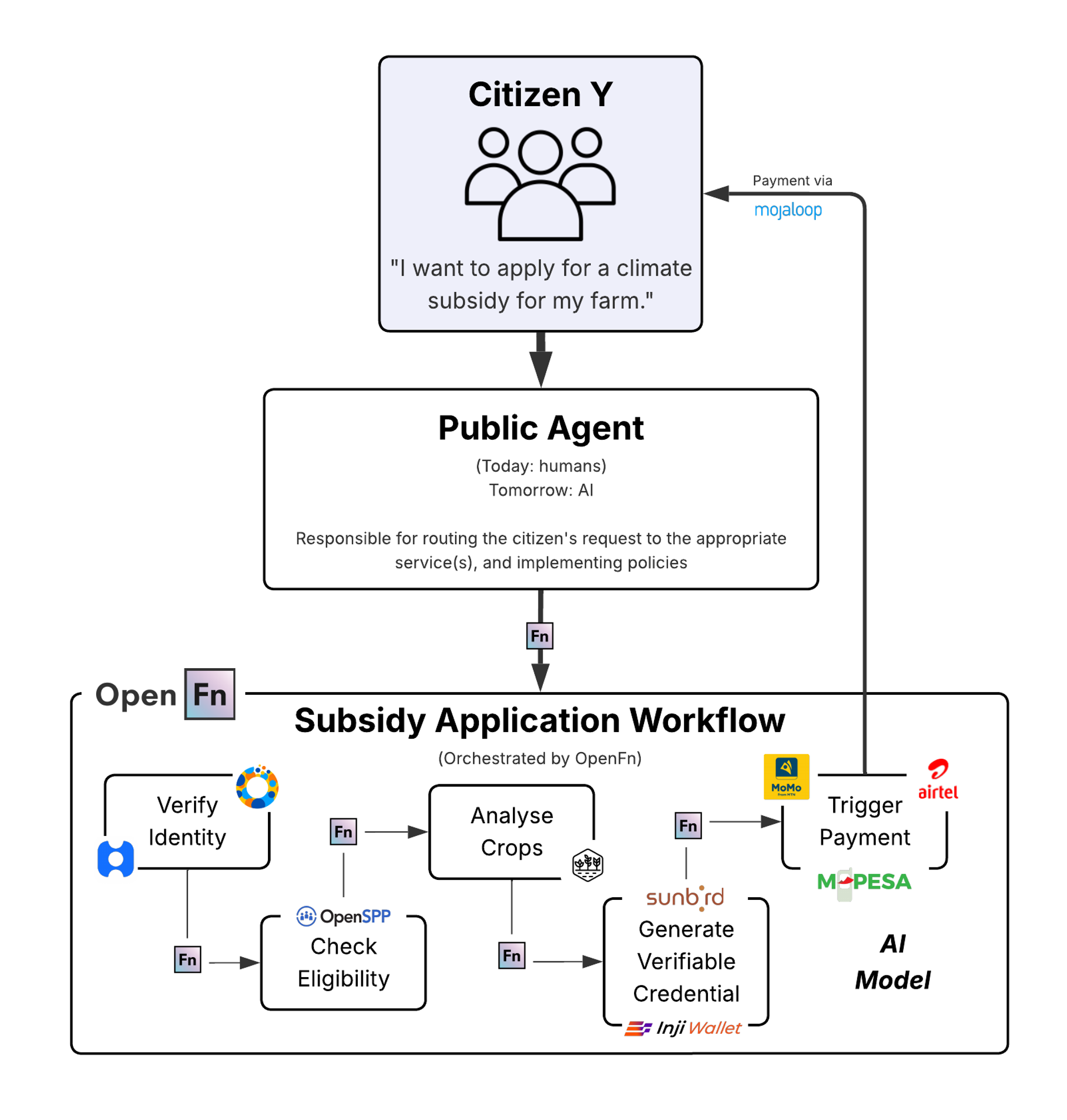
Fig 1: Farmer Subsidy Application Workflow - serving a citizen need
Increasingly though, AI Agents are capable of retrieving, synthesizing and editing information in each of these building blocks automatically. That capability demonstrates enormous promise for increasing the efficiency of service delivery. Such AI agents can effectively leverage the foundational building blocks provided by Digital Public Infrastructure, and deliver genuine impact for citizens.
Indeed, Digital Public Infrastructure (DPI) is defined by the combination of modular building blocks: identity/credentialing systems, payment switches and services, data and geo-spatial registries and, increasingly, AI blocks. The OpenFn product provides the mortar between those bricks. No matter the shape of your preferred bricks, the OpenFn platform exists to bring those bricks together to build secure, stable, and scalable structures.
DPI is defined by modular building blocks, OpenFn provides the mortar.
The Value of the Orchestration Layer
As AI adoption becomes an imperative for efficiently delivering public services, management and oversight of such AI activity requires putting public infrastructure at the heart of the technical architecture. Without effective orchestration, even the most sophisticated AI agents will remain isolated tools rather than transformative systems capable of delivering integrated, citizen-centered services. The orchestration layer is where data, AI, business logic, and context come together to deliver public services to those that need them.
A publicly owned Orchestration Layer enables governments to:
- Coordinate AI Agents to deliver complex ‘DPI Workflows’ for citizens in a predictable manor, avoiding uncoordinated AI and architectural sprawl
- Responsibly manage access to foundational systems of record (like other DPI Building Blocks) and 'scrubbing' citizen PII when necessary to adhere to data laws
- Observe and audit workflow executions for public accountability
- Abstract rules based execution logic from Agentic AI tooling
- Monitor the performance of different AI models, tools and blocks, including small language models and commercial providers, via a framework of A/B Testing for continual improvement
- Ultimately, commoditise AI tools and service providers by creating a competitive landscape, such that providers compete on price, quality and safety in the public interest
Imagine ‘Flight Radar’ for public service delivery. With a publicly available Orchestration Layer, the flow of data and agents across an ecosystem can be monitored in real time. Available metadata can be publicly audited, and safeguards can become tangible artifacts to be observed, questioned and improved.
Citizens must trust that government AI systems operate fairly, protect privacy, and remain accountable for decisions. This trust cannot exist if the software systems delivering services remain opaque. An Orchestration Layer helps to bring organisation to Agentic chaos, and bring this activity out into the open.
The danger of private capture
History shows what happens when core software infrastructure falls into private hands before public alternatives mature. Payment switches like Vocalink (Mastercard) established vertical capture across much of the world before initiatives like Mojaloop Foundation could provide public alternatives. Governments are now working to correct that imbalance through adoption of publicly owned payment switches to process digital financial transactions - putting such innovation under public ownership instead of serving shareholders through rent extraction.
The exciting Horizon1000 project recently created a stir around the ICT4D landscape. Such projects aim at realising the very promise of AI adoption that many of us are excited about. However, the danger of over-reliance on singular vendors should not be underestimated. OpenAI have built and released their own agentic management platform which may make short term sense to adopt as part of such projects. But, when a single vendor controls the AI models, the guardrails, and the protocols through which they coordinate (and access foundational DPI systems), switching costs become prohibitive and vendor lock-in of crucial state apparatus is inevitable.
Why the Orchestration Layer must be publicly owned
A public orchestration layer must be abstracted from commercial AI providers. Like a public utility, the Orchestration Layer provides foundational capability required to responsibly deliver public services. With this layer, governments (on behalf of their citizens) can commoditize different AI providers and hold them in competition with each other, and also compare them with more efficient, ‘home-grown’ alternatives as they emerge.
Public ownership of this layer as an open source solution also builds trust through transparency. Open source ‘rails’ will allow public scrutiny over how data flows through the system, verification of security implementations, and empower governments to host themselves, avoiding lock-in.
OpenFn as public orchestration infrastructure
OpenFn is the leading Digital Public Good (DPG) for data exchange and workflow automation. It is an accredited DPI Building Block - used by governments and NGOs and deployed across 60+ countries, processing millions of workflow runs annually.
OpenFn has long been used to stitch together ‘old school’, deterministic, foundational systems of record. The platform exists to make ‘interoperability’ more than just a buzzword, by actually stitching together disparate systems to form harmonious solutions. Increasingly, this same integration layer is being leveraged to safely adopt and manage AI Blocks.
The platform is fully open source and publicly accessible, currently stewarded by Open Function Group, a Benefit Corporation with no VC-investors, and an explicit commitment to avoiding profit-maximization.
The capabilities we have been building for deterministic workflow automation translate directly to agentic orchestration. Whether a human administrator triggers a workflow or an AI agent initiates coordination, the underlying infrastructure must authenticate requests, transform data between different system formats, handle errors gracefully, maintain complete audit trails, scale to handle high transaction volumes, protect or scrub sensitive information in transit, and enable monitoring and oversight. OpenFn provides all these capabilities today.
In Thailand, UNICEF and the Ministry of Public Health use OpenFn to automate workflows between Primero (UNICEF’s Case Management DPG) and Thailand’s own government-operated risk profiling AI model. When a vulnerable child enters a One Stop Crisis Centre, caseworkers can instantly access risk assessments and medical history in Primero’s interface. OpenFn provides secure orchestration between these systems. If a better risk profiling AI model enters the market tomorrow, the cost of switching to that new model is minimised by OpenFn being in place. ‘Plugging in’ and ‘plugging out’ AI and Agentic Models from core state apparatus becomes a short, achievable project, rather than an unrealistic goal.
This is orchestration infrastructure in action. Multiple specialized systems, each with distinct purposes and data models, coordinating to deliver integrated services. Caseworkers focus on providing care rather than navigating technical barriers. Children receive better protection because the right information reaches the right people at the right time. As the cost of code falls, the process of adopting, testing and monitoring new tools also falls.
Increasingly, OpenFn is being used in that same way to bring together non-deterministic “AI Agents” in service of the public. The product is primed and ready to support governments around the world to manage their own infrastructure—not to become reliant on external vendors.
Building toward the future
Countries do not need to wait for perfect agentic systems to begin this transformation. They can start by opening APIs on existing systems to enable programmatic access while maintaining security and oversight. They can implement workflow automation for high-volume, rules-based processes to build operational experience before adding AI reasoning. They can establish data governance frameworks that specify what information can flow between which systems under what conditions. They can build monitoring capabilities to track how automated systems perform in practice.
OpenFn supports all these steps. Our platform enables governments to modernize their orchestration infrastructure incrementally, starting with manual workflow automation and evolving toward AI-enabled coordination as capabilities mature and confidence grows.
The transformation to AI-enabled government represents one of the most significant shifts in public administration in generations. Success requires getting many things right simultaneously, from technical infrastructure to legal frameworks and organizational culture.
This infrastructure must be publicly owned, open source, and built on transparent standards. It must embed guardrails for accountability, security, and privacy from the start. And it must scale to handle coordination across thousands of systems while maintaining human oversight and governance.
The future of government is being built right now. The question is whether that future will be built on publicly-owned infrastructure that provides public value, or on proprietary platforms that prioritize commercial interests and profit maximisation. We’re here fighting for public value. Join us.
For more info on how OpenFn is thinking about the use of AI at “build time” vs “runtime” today, see this 4 minute video of the platform in action.
Disclosure: We use AI to improve research, organization, and content development in our writing.

Written by
Jack Hilton